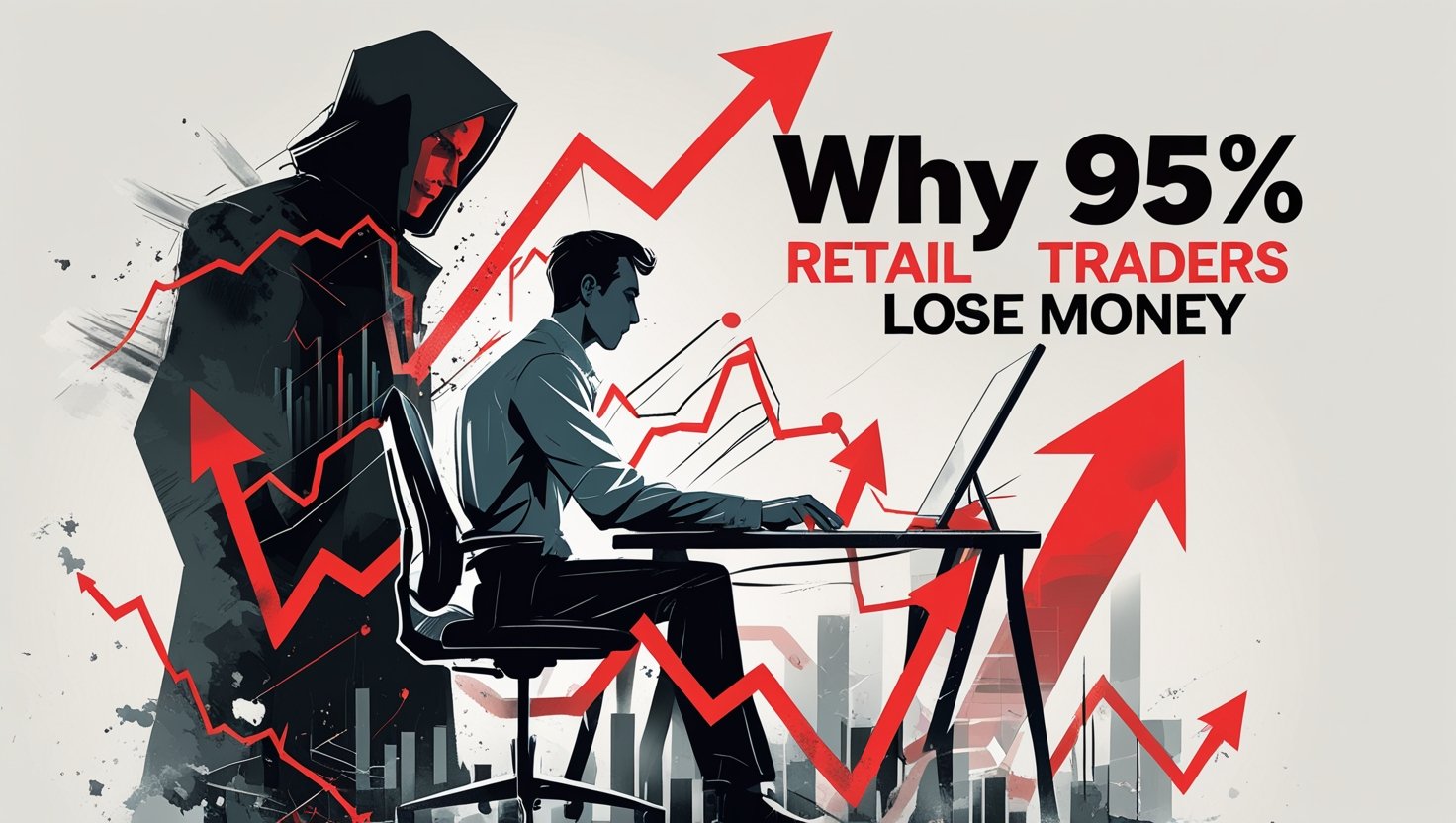
For most beginners, the stock market looks like a golden ticket. Open your phone, download a trading app, and within minutes, you’re ready to “make money.” Reels, YouTube shorts, and Telegram channels promise strategies that can turn ₹10,000 into ₹1 lakh in no time. Every day, someone is flaunting screenshots of massive profits. And like millions of new traders in India, you ask yourself: If they can do it, why can’t I?
You start trading. Sometimes you make a little profit, sometimes you face a loss. But gradually, the losses start piling up. Before you realize it, your account is drained. You’re left confused: Was the strategy wrong? Did you not learn enough? Or is trading simply a gamble designed to make you lose?
The truth is far more complex. Trading is not just about charts and candlesticks. It is an entire ecosystem where your every move generates money if not for you, then for someone else. Understanding this system is the first step to realizing why 95% of retail traders end up losing their hard-earned money.
Trading Is an Ecosystem, Not a Shortcut:
The first myth most people believe is that trading is simply a knowledge game. If you just learn the right strategy, the right indicator, or the right pattern, you will unlock profits. But reality is different.
Trading is an ecosystem designed to make money from every trade, regardless of whether you win or lose. When you buy or sell, multiple institutions benefit: the broker takes brokerage and hidden charges, the stock exchange collects transaction fees, clearing corporations earn settlement fees, and depositories charge annual maintenance and transaction costs. This cycle continues as long as you keep trading.
Meanwhile, big institutions, hedge funds, and market makers—armed with massive capital, advanced technology, and better data dominate the market. Their large trades worth hundreds of crores move prices, while retail traders merely react. In effect, retail traders don’t drive the market; they supply liquidity for those who do.
Why Retail Traders Don’t Move the Market:
Think of it this way: if one crore small traders each invest ₹500 in different stocks, the demand is scattered and barely noticeable. But if a large institution invests ₹100 crores in a single stock at once, that is enough to shift its price.
This is why the market doesn’t really move on the back of retail traders. The big players dictate direction, while small traders follow along and often get trapped. The system thrives on your reactions. When you buy high out of excitement or sell low out of fear, you are feeding liquidity into the machine. Whether you gain or lose doesn’t matter. What matters is that the system profits every time you click buy or sell.
The Social Media Illusion:
If trading is so risky, why does it look so glamorous on Instagram and YouTube? The answer lies in the rise of trading influencers.
Scroll through social media and you’ll see endless promises: “Make ₹15,000 in 10 minutes.” “iPhone in one trade.” “Join my premium group for jackpot calls.” These messages target your emotions, your fear of missing out, and your greed for quick wealth.
But here’s the uncomfortable truth: most of these influencers don’t make their income from trading. They make it from selling courses, mentorship programs, paid Telegram groups, or affiliate deals. Their profits come from convincing you that they have the secret success formula.
Even the screenshots they post can be easily manipulated. A PNL statement can be created with Photoshop in minutes. Behind the few profitable trades they showcase are dozens of losses, breakdowns, and failures that you never see. Their goal is not to teach you trading; it is to keep you hooked in a loop of doubt, always coming back for the next tip or the next course.
The Psychological Trap:
While the system itself is stacked against retail traders, the deadliest weapon of the market is psychological manipulation.
The first loss hurts financially, but the real damage happens in your mind. After a win, you start believing you’ve cracked the code, and overconfidence makes you take bigger risks. After a loss, you desperately try to recover your money through revenge trading. Both emotions, greed and fear, push you into irrational decisions.
This cycle is similar to gambling. You think you are playing against the market, but in reality, you are playing against your own mind. Trading, therefore, is less about knowledge and more about self-control, patience, and discipline. And this is where most retail traders fail.
Why Learning More Doesn’t Always Help:
When a trader keeps losing, the natural reaction is to “learn more.” You study more indicators, download more algorithms, and follow more Telegram tips. But the problem is not just knowledge. It’s understanding the nature of the game.
You can learn every candlestick pattern, but if you don’t understand risk management and emotional control, you will still lose. You can buy every strategy, but without discipline, you will abandon it after a few losses. The stock market does not reward half-prepared soldiers. It punishes them.
What the Numbers Really Say:
According to SEBI, more than 80% of people who placed over 500 trades in a year ended up losing money. Only 1% earned more than ₹1 lakh. And on average, just one out of ten retail traders made any profit at all.
These numbers prove that trading is not designed to make everyone rich. It is a highly competitive field where professionals with deeper pockets, faster systems, and better information already dominate the game.
The Way Out: From Trading to Investing:
Does this mean making money in the stock market is impossible? Not at all. But it requires a complete shift in mindset.
If your goal is quick profits, trading will almost always disappoint you. But if your goal is long-term wealth, investing is your best friend. Unlike trading, investing does not rely on predicting every market move. It is about buying high-quality businesses, mutual funds, or index funds and holding them over time.
Creating a portfolio, diversifying across asset classes, automating SIPs, and maintaining patience can actually lead to wealth creation. Unlike trading, investing does not drain your psychology with daily ups and downs. Instead, it leverages time and compounding to your advantage.
Lessons the Market Teaches:
Every trader who has lost money often refers to it as “tuition fees.” The stock market does not hand out degrees, but it gives scars, and those scars teach the most valuable lessons.
You cannot shortcut your way to wealth. You cannot outsmart the market with a “15-minute daily strategy.” What you can do is respect the complexity of the system, learn risk management, control your emotions, and focus on long-term investing instead of gambling your savings away.
Conclusion:
The reason 95% of retail traders lose money is not just a lack of knowledge or the use of wrong strategies. The very structure of the market, the influence of large institutions, the trap of social media gurus, and the psychology of trading all combine to push small traders into loss.
Trading is not impossible, but it is not easy. It is not a shortcut, but a full-time profession demanding years of practice, discipline, and mental strength. For everyone else, the path to financial stability lies in patient investing, not impulsive trading.
In the end, the market is a machine. You can either fuel it with your losses or harness it with discipline and long-term vision. The choice, as always, is yours.
FAQs:
1. Why do most retail traders lose money in the stock market?
Most retail traders lose because the market is structured to benefit institutions, brokers, and exchanges, not small players. High transaction costs, lack of capital, poor discipline, and psychological traps like greed and fear push beginners into losses.
2. Is trading really just gambling?
Trading is not gambling in itself, but without discipline, risk management, and emotional control, it becomes very similar to gambling. Most retail traders treat it like a quick-profit shortcut, which makes it as risky as a casino bet.
3. Do social media trading influencers actually make money from trading?
In most cases, no. Many influencers earn money by selling courses, mentorship programs, and premium Telegram groups rather than from trading itself. Their flashy profit screenshots are often exaggerated or manipulated to attract followers.
4. Can retail traders ever succeed in trading?
Yes, but success is rare and requires years of experience, strict discipline, and strong psychological control. Trading has to be treated as a full-time profession, not as a shortcut to quick wealth.
5. What is a safer alternative to trading for wealth creation?
Long-term investing in high-quality businesses, mutual funds, or index funds is a safer and proven way to grow wealth. Unlike trading, investing leverages compounding and patience, making it suitable for most people who want financial stability.